The Words of Odin: A New Rendering of Havamal for the Present Age by Artisson Robin
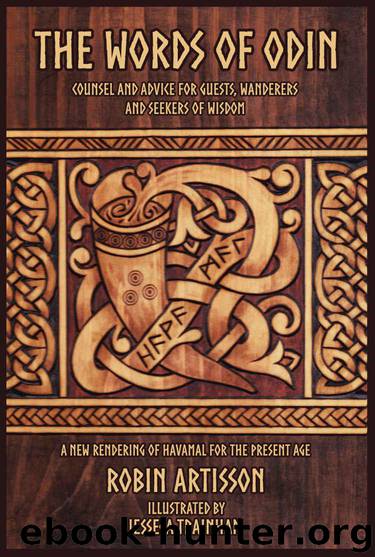
Author:Artisson, Robin [Artisson, Robin]
Language: eng
Format: mobi, epub, azw3
Published: 2016-12-27T16:00:00+00:00
Meyjar orðum
skyli manngi trúa
né þvís kveðr kona,
þvít á hverfanda hvéli
váru þeim hjörtu sköpuð,
ok brigð í brjóst of lagið.
Translated, word for word, and quite literally, it seems to say "Of a maid (a young woman) her words should no man put trust in. Nor what a woman (or wife) should say (or sing, recite, pledge.) Because on a turning wheel their hearts were shaped (or created.) A fickleness (or a breach, a tendency to break things) lays in their breasts."
The first part of this verse needs little defense; "maiden" refers to very young women, who like very young men, lack the lived experience and wisdom to understand the true gravity of words and oaths. But the untrustworthiness of mature women (kona), who can also be wives, is another matter. Their hearts are said to have been shaped on a turning wheel (often understood by translators to be a potter's wheel but that may not be fully accurate) and in their breasts lies a fickleness or a "tendency to breach" things, like oaths and agreements.
Before we can really understand what this means, we need to understand that women in Old Norse society had the privilege of being able to divorce their husbands at will. Few people today, even those most concerned with women's equality issues, really grasp how much power and independence this gave women in the past. To say that someone's heart was shaped on a turning (or whirling or spinning) wheel is to say that the heart is changeable; and yet, it is true that men and women's hearts are both quite changeable. Odin's statement about women here sounds, on the surface, needlessly pejorative, but when you consider that there is a special association of women or the female form with turning and spinning powers, it makes a touch more sense. The Fates themselves are depicted in Old Norse societies as female. They spin the threads of every life; there is an association of the word "wyrd", or Fate, with "turning"- these Nornic powers stand behind even the destinies of the Gods. To depict them as women means that an aesthetic connection existed in the minds of Heathen people between the female form itself and the power of Fate- Fate, which could be kindly one day, and cruel the next. Odin is not lacking in criticism against men; within a few verses of this one, he calls men liars and manipulators, presenting them as untrustworthy, too.
Now, back to the literal Old Norse lines: the term brigð is the term that has caused this passage to seem so problematic. Brigð literally means "breach." Yves Kodratoff, on his incredible website devoted to Old Norse literature (nordiclife.org/nmh) has a beautiful and revealing discussion about the word brigð and its meaning in this verse. By itself, brigð cannot simply mean "fickle," though nearly every translator before now has rendered it that way. Brigð needs to be connected to another word before it fully makes sense in this kind of usage. The example Kodratoff gives
Download
The Words of Odin: A New Rendering of Havamal for the Present Age by Artisson Robin.epub
The Words of Odin: A New Rendering of Havamal for the Present Age by Artisson Robin.azw3
This site does not store any files on its server. We only index and link to content provided by other sites. Please contact the content providers to delete copyright contents if any and email us, we'll remove relevant links or contents immediately.
Cecilia; Or, Memoirs of an Heiress — Volume 1 by Fanny Burney(32527)
Cecilia; Or, Memoirs of an Heiress — Volume 2 by Fanny Burney(31928)
Cecilia; Or, Memoirs of an Heiress — Volume 3 by Fanny Burney(31916)
The Great Music City by Andrea Baker(31902)
We're Going to Need More Wine by Gabrielle Union(19020)
All the Missing Girls by Megan Miranda(15892)
Pimp by Iceberg Slim(14464)
Bombshells: Glamour Girls of a Lifetime by Sullivan Steve(14038)
For the Love of Europe by Rick Steves(13822)
Talking to Strangers by Malcolm Gladwell(13332)
Norse Mythology by Gaiman Neil(13317)
Fifty Shades Freed by E L James(13216)
Mindhunter: Inside the FBI's Elite Serial Crime Unit by John E. Douglas & Mark Olshaker(9298)
Crazy Rich Asians by Kevin Kwan(9262)
The Lost Art of Listening by Michael P. Nichols(7476)
Enlightenment Now: The Case for Reason, Science, Humanism, and Progress by Steven Pinker(7288)
The Four Agreements by Don Miguel Ruiz(6729)
Bad Blood by John Carreyrou(6601)
Weapons of Math Destruction by Cathy O'Neil(6248)
